Industrial integration platform

Metis Axis from field to enterprise.

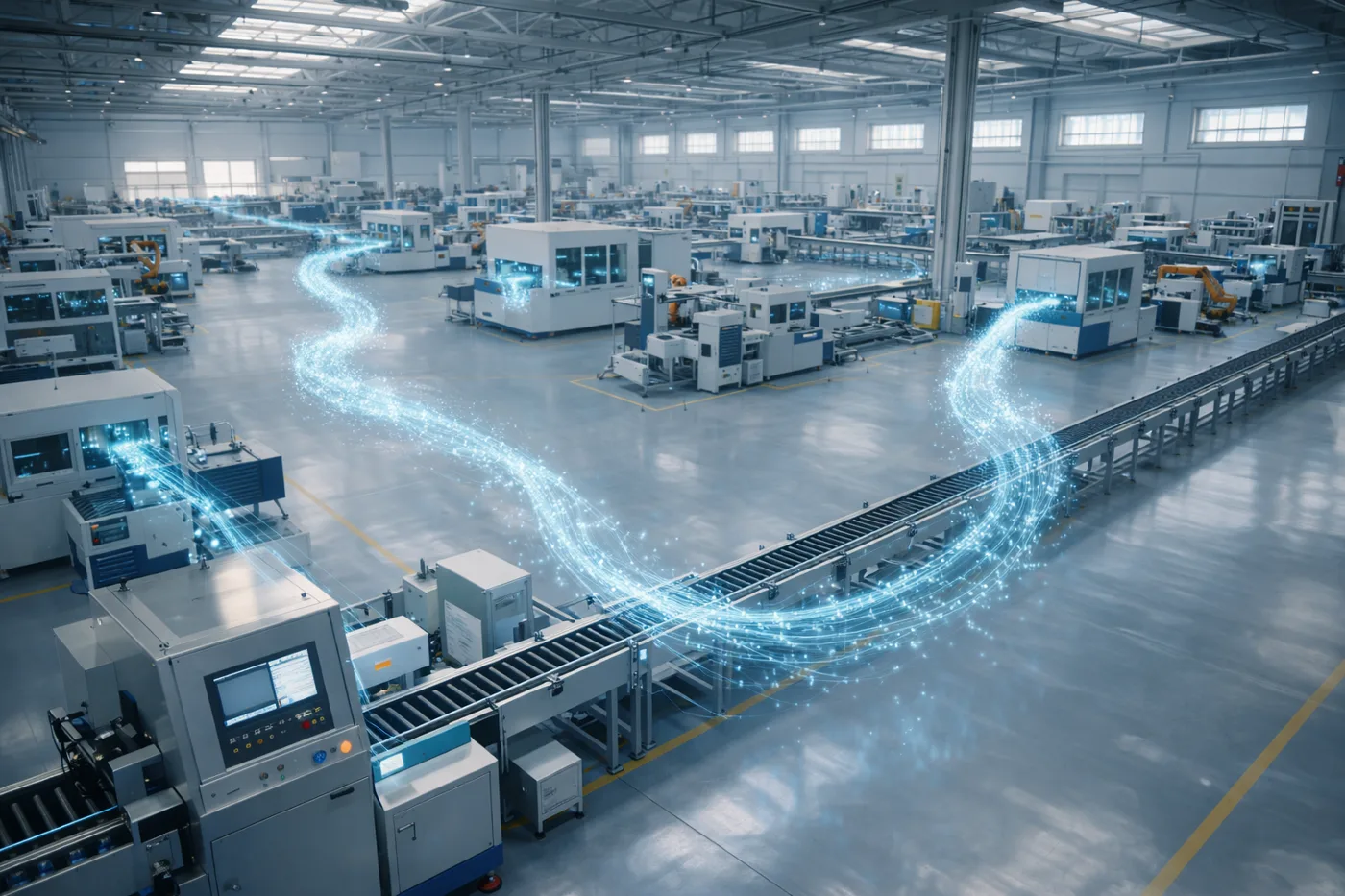
Metis Axis unites the entire data flow from the shop floor to enterprise systems in a single software layer and makes operational processes programmable.
Capabilities

Edge intelligence

Processes data from field devices instantly and produces on-site decision support.

AI-assisted automation

Interprets alarms and events; suggests priorities and actions.

Cloud-connected production

Synchronises plant data with cloud services for remote monitoring and reporting.

PLC and process intelligence

Puts PLC and process signals into context and turns them into meaningful insight on operator screens.

Human-machine collaboration

Brings operators, engineers and managers together in shared task and feedback flows.

Management visibility

KPIs, alarms and work order status at a glance.

Architecture

Three layers work in one flow, from the signal on the shop floor to the record in the enterprise system.
Connectivity
Data collection from PLC/SCADA, industrial printers, sensors and edge devices.
Integration layer
Two-way integration with enterprise applications through REST/WebSocket, messaging and ERP/CRM/WMS connectors.
Programmable layer
No-code flows, C#/Python steps, schedulers, alarm scenarios and Metis Agent tools.

Screens from the application

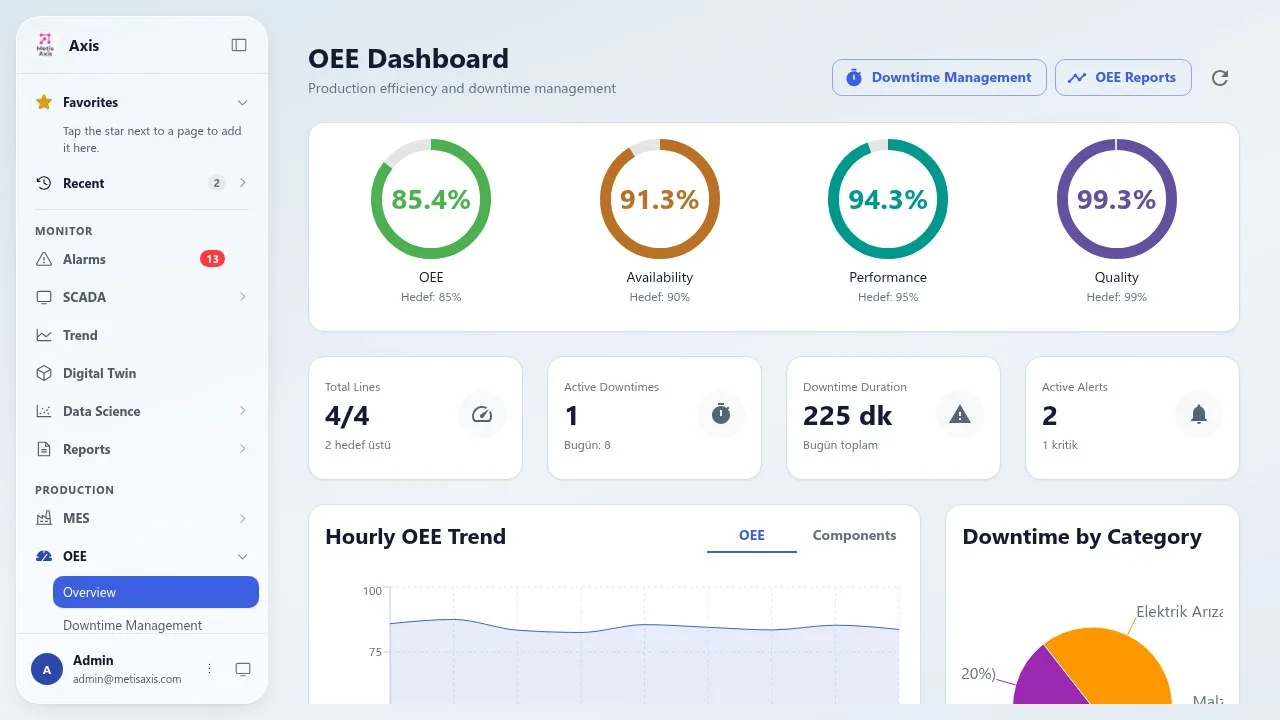
OEE and downtime analysis
OEE and downtime analysisAvailability, performance and quality; hourly trend and downtime causes.
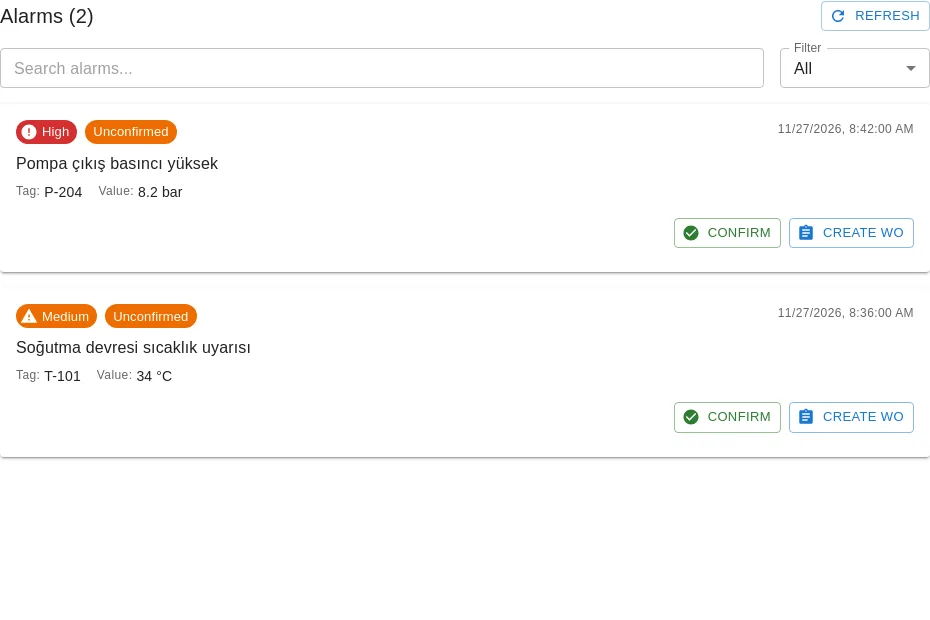
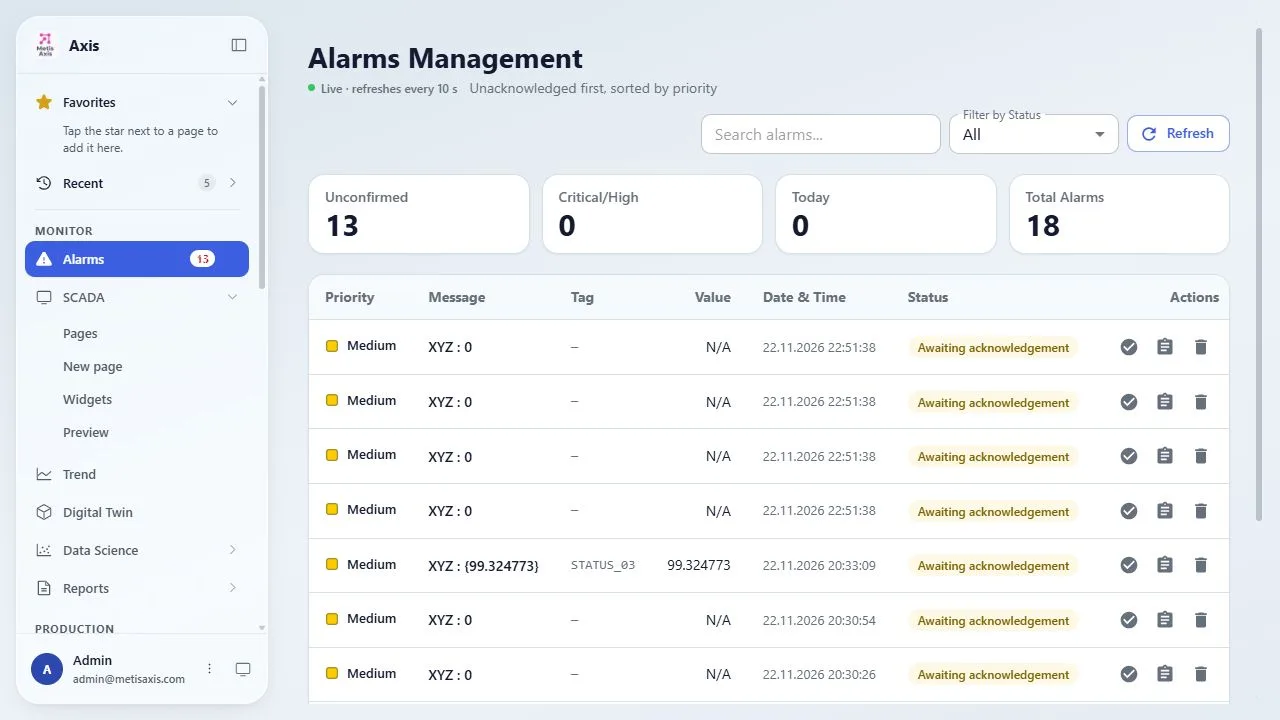
Alarm center
Alarm centerAlarm monitoring and acknowledgement with level, status and history filters.
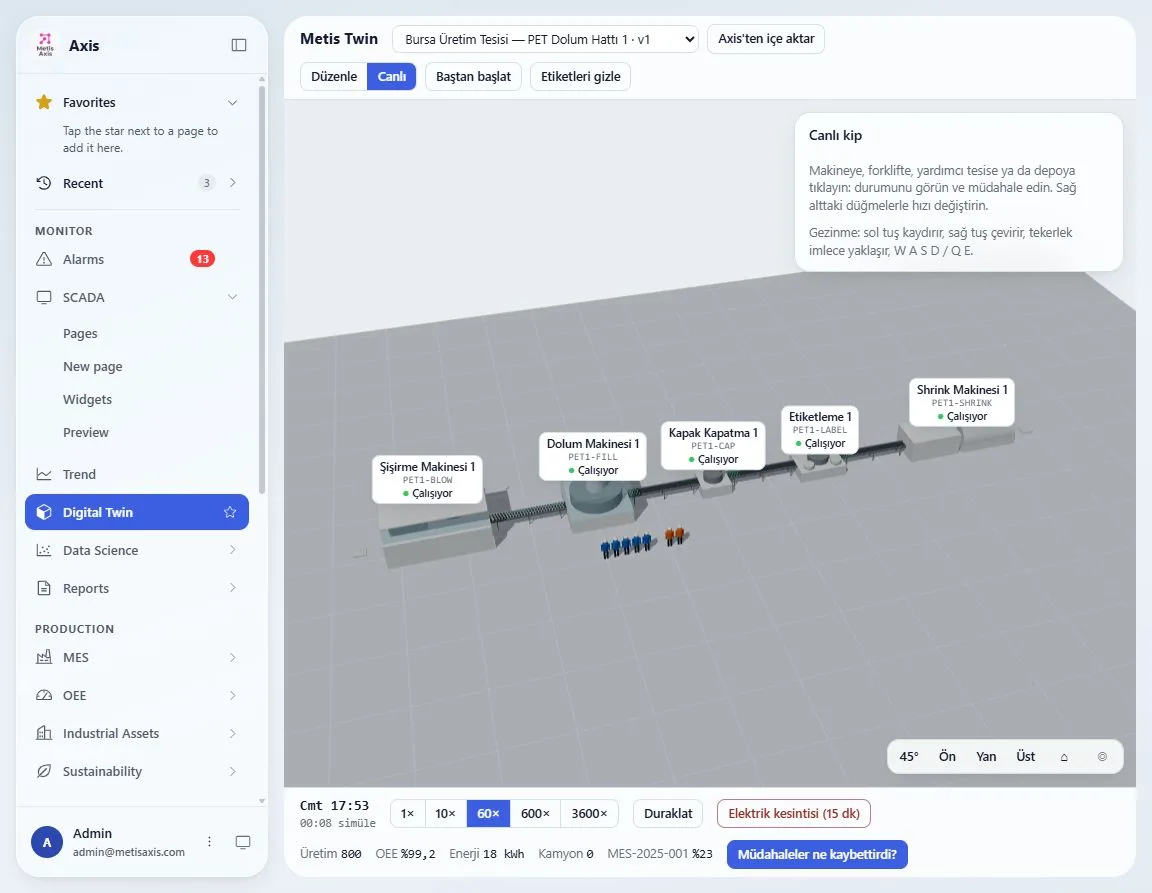
Digital twin
Digital twinEquipment status and signals on a live model of the plant.
Field app
Field appMobile work order and alarm management; works offline.

Modules

34core modules
90+sub-features
1platform
Orchestration and integration12
1. Dashboard
Task management, active workflows, and system status summaries.
2. MetisFlow
Drag-and-drop design with conditions, loops, service calls, PLC commands, email/SMS/WhatsApp, and alarm nodes.
3. Monitoring
Real-time system and task monitoring.
4. Code Editor
Python/C# code authoring and execution.
5. SCADA System
Page designer, widget ecosystem, runtime, alarm center, periodic scheduler, and templated work orders.
6. Data Sources
Channel management, tags, and OPC/Socket/WebSocket connectors.
7. Services
SOAP/REST web services, database services, integration management.
8. Variables
Global workflow variables and tag-based logic.
9. Templates
Reusable workflow and task template library.
10. Trend Analysis
Time-series visualization and historical data analysis.
11. Alarms
Real-time alarm monitoring, acknowledgment, history, and severity filtering.
12. Reporting
Describe the report in plain language; schema-based, read-only SQL is generated and validated. Saved reports, drag-and-drop report dashboards and schema discovery on SQL Server data sources.
Maintenance and field operations7
13. Work Orders
Creation, lifecycle flow (Open-In Progress-Completed), photo evidence, assignment, and tracking.
14. Locations/Equipment/Operations
Asset and operation definitions linked to work orders.
15. Skills & Employees
Skill definitions, workforce management, and skill-based assignment.
16. Planned Maintenance
Maintenance templates, recurring schedules, and automatic work-order generation.
17. Maintenance Calendar
Weekly/monthly planning views with status coloring.
18. Maintenance Management
Dashboard, spare parts, equipment health, KPI reports, predictive maintenance, TPM, external services.
19. Industrial Assets
Factories, lines, machines, downtime reasons, and shift planning.
Production and performance8
20. MES
Production orders, recipes, operator tasks, WIP dashboard, bottleneck analysis.
21. OEE
Dashboard, downtime management, speed profiles, targets, reports, and performance alerts.
22. Quality Control
Inspections, defects, SPC, sampling plans, NCR, and CAPA.
23. Traceability
Raw materials, suppliers, lots, batches, serials, packaging, shipments, trace queries, recalls.
24. Data Science
Correlation, anomaly detection, forecasting, clustering, root-cause analysis, health score.
25. Sustainability
Emission factors, source tracking, carbon calculator, water footprint, product CFP, CBAM reports.
26. Energy Optimization
Energy profiles, auto shutdown rules, peak-hour management, line-level carbon tracking.
27. Digital Twin (Metis Twin)
Model the plant parametrically with lines, stations, machines, conveyors, buffers and forklifts; find the bottleneck with discrete-event simulation, test failure scenarios, compare scenarios and search for the best buffer, shift or fleet settings. Live view in a 3D scene.
Extensibility and AI2
28. Plugins
Plugin library, instance management, trigger configuration, and extensible device connectivity.
29. Metis Agent
AI-powered automation agent and tool configuration.
Governance, security and mobile5
30. User Management
Accounts, profile administration, role assignment.
31. Group Management
Group structures, member assignment, group-level permissions.
32. Authorization
Granular module-level and action-level access control.
33. Settings
Email (SMTP), SMS and WhatsApp provider settings, theme/language/system preferences.
34. PWA - Mobile Field App
Mobile-optimized work order and alarm workflows, camera integration, and offline support.

Which process shall we automate together?

Tell us about your field data, the systems to connect and the outcome you expect; we will plan the demo around your scenario.

Talk to the team